Deep Dive Case Study: Woodworking — Intelligence, Safety, and Craft Amplification
1. Executive Summary
Woodworking is one of the oldest forms of human making—and one of the most dangerous, labor-intensive, and underserved by advanced technology. Despite modern tools, most woodworking remains manual, physically demanding, and performed alone. Serious injuries are common, highly consequential, and often preventable. At the same time, the joy of woodworking lies precisely in its hands-on nature, creativity, and connection to material.
This case study explores how Generative Logic Unbounded (GLU) can be applied to woodworking in a way that amplifies craft rather than automates it away. The goal is not to replace the woodworker, but to:
· Remove the most laborious and injury-prone steps
· Enhance precision and repeatability without reducing creativity
· Increase safety for solo operators
· Preserve and extend tacit knowledge
The GLU approach demonstrates how the right technology, applied thoughtfully to the right problem, can unlock significant human, economic, and safety benefits in a domain that most advanced AI efforts ignore entirely.
2. The Problem Space
2.1 A Highly Manual and Hazardous Domain
Woodworking involves rotating blades, high-speed cutters, heavy stock, dust inhalation, noise exposure, and sustained physical strain. Many operations—flattening, jointing, sanding, dimensioning, and shaping—require repetitive passes and intense focus. Fatigue is a common contributing factor to accidents.
Key characteristics:
· Predominantly manual workflows
· Frequent solo operation
· High reliance on tacit skill and experience
· Limited digital feedback or real-time safety awareness
2.2 Injury Landscape and Cost
Woodshop injuries range from minor lacerations to life-altering trauma such as finger or hand amputations. Table saw accidents alone account for tens of thousands of emergency room visits annually in the U.S.
Typical impact per serious injury:
· Direct medical costs: tens to hundreds of thousands of dollars
· Lost income and productivity
· Long-term physical and psychological consequences
· Insurance, liability, and legal exposure
Despite this, most safety solutions focus on reactive protection
(guards, PPE) rather than intelligent prevention and response.
3. Why Conventional Technology Fails Here
3.1 Automation Misses the Point
Full automation (e.g., industrial CNC-only workflows) removes the maker from the process. and are very limited in their scope of operation. This is undesirable for hobbyists, artisans, and small shops where the act of making is the point. Further, the CNC machines often require investments in setup, programming, tooling that are often only seen in more commercial workshops.
3.2 Existing Smart Tools Are Narrow
Most "smart" woodworking tools address a single operation, lack contextual understanding, do not integrate across the shop, and offer little adaptability to individual skill levels.
3.3 Market Perception Bias
Advanced AI investment targets scale-heavy domains (finance, advertising, logistics). Woodworking is perceived as too niche, too analog, and too irregular—leaving a large gap where high leverage per user is possible.
4. The GLU Approach to Woodworking
4.1 Design Philosophy
GLU treats the woodshop as an intelligent environment, not a set of isolated tools. The system amplifies human judgment, reduces risk, and augments capability—without removing agency or joy.
Core principles:
· Human-in-the-loop by default
· Context-aware assistance
· Progressive autonomy (assist → warn → intervene)
· Safety and creativity are complementary
5. Capability Areas
5.1 Intelligent Safety & Injury Prevention
Using vision systems, motion tracking, and tool telemetry, GLU can detect unsafe hand proximity or body positioning, recognize fatigue or distraction patterns, issue escalating warnings (visual, audio, haptic), and automatically shut down tools when thresholds are exceeded.
Unlike static safety systems, GLU adapts to the user, task, and material.
5.2 Solo Operator Emergency Response
If an accident occurs, multimodal sensors detect abnormal motion, sound, or posture; the system assesses probable injury severity; video and contextual data are captured; emergency services and designated contacts are notified; and information is transmitted to speed EMT response.
This can dramatically reduce time-to-care in solo-shop scenarios.
5.3 Labor Reduction Without De-Skilling
GLU-assisted systems can automate or semi-automate sanding and flattening via CNC or robotic assistance; capture complex, irregular shapes using 3D vision and scanning; translate physical objects into editable digital representations; and enable precise replication or repair of damaged components.
The craft remains human-driven; the drudgery does not.
5.4 Knowledge Capture and Skill Transfer
By observing workflows, GLU can document expert techniques, suggest alternative approaches, and help less experienced woodworkers avoid common mistakes—preserving knowledge that is traditionally lost.
6. Notional System Architecture
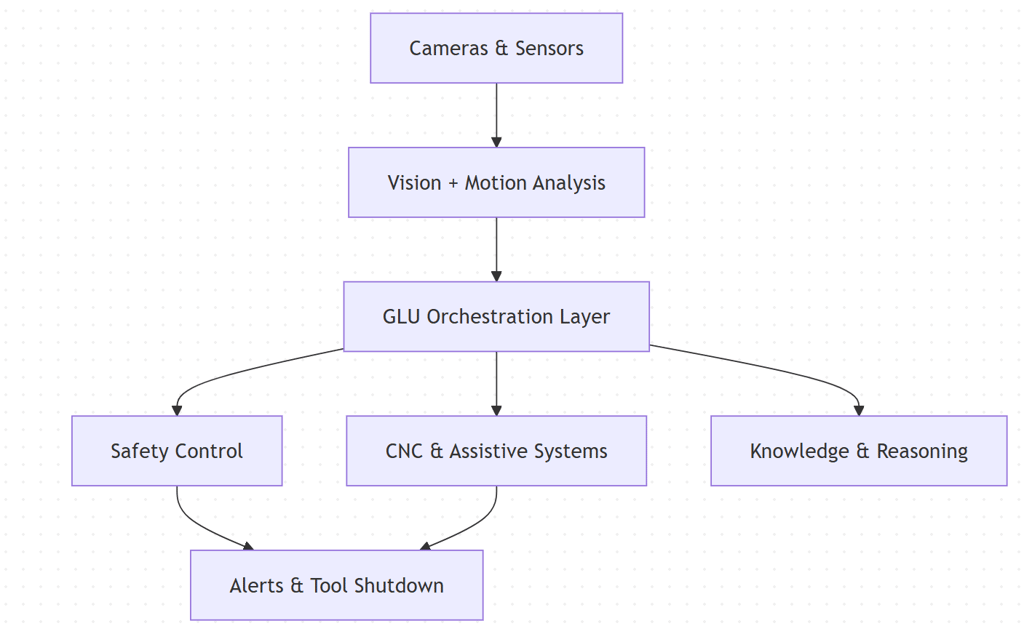
6.1 High-Level System Diagram (Conceptual)
6.2 Technology Stack (Illustrative)
· Vision: RGB + depth cameras, edge AI inference
· Sensors: IMU, vibration, audio, dust, power draw
· AI Models: LLMs, multimodal reasoning models
· Control: CNC interfaces, relay-based tool shutdown
· Orchestration: GLU logic layer coordinating intent, context, and action
· Deployment: Local-first processing with optional cloud escalation
7. Business & Market Analysis
7.1 Market Context: Tools, Shops, and Spend
Even though woodworking is often treated as a niche, it sits at the intersection of durable markets: power and hand tools (consumer + prosumer), small professional shops (cabinetry, furniture, millwork), makerspaces and schools, and home improvement/DIY.
Multiple market reports place the global hand/woodworking tools market in the high single-digit billions (USD) annually, with steady growth. These reports vary in definition and scope, but they consistently support the conclusion that the tool ecosystem is large enough to sustain meaningful adjacent categories such as safety systems, sensing, software, and services.
Implication: a GLU-enabled woodworking safety + capability layer does not require big-tech scale to be viable; it requires high leverage and clear value per user.
7.2 Injury and Accident Burden
Woodworking is a high-consequence activity. Stationary saws (especially table/bench saws) and related shop operations produce a meaningful annual injury burden. Public estimates for ED-treated table/bench saw injuries are on the order of tens of thousands per year in the U.S., with a meaningful fraction involving severe lacerations and amputations.
Cost per serious injury varies widely by severity and what is counted (direct medical cost vs. indirect cost such as lost income, retraining, long-term disability, and quality-of-life impact). Published and cited estimates commonly range from tens of thousands of dollars for many injuries to far higher figures for catastrophic outcomes.
Implication: preventing even a small number of catastrophic incidents can justify a premium price point for intelligent safety and rapid-response systems, even in a domain viewed as niche.
7.3 Notional Market Value (Impact-Driven View)
A simple impact framing treats GLU woodworking systems as: (1) a safety and risk-reduction product (loss avoidance) and (2) a capability and productivity product (time savings, error reduction, repeatability).
If the U.S. burden of table saw injuries alone is in the billions annually, capturing even a low single-digit percentage of injury prevention value represents a large addressable opportunity. If a safety + emergency response system prevents or mitigates one catastrophic injury for a small professional shop, the avoided cost can exceed the price of the system many times over.
This is especially powerful because the value is not merely convenience; it is life, limb, time-to-care, and long-term quality of life.
7.4 Buyers and Adoption Path
Likely early adopters: solo professional shops and high-volume small makers; schools and makerspaces with elevated liability exposure; and safety-forward hobbyists.
Entry products that avoid overreach:
· Safety monitor + warning system (non-invasive, low friction)
· Emergency response layer (auto-detect, contacts, video capture)
· Labor-reduction assistants (shape capture, dimensioning, replication workflows)
This aligns with GLU’s philosophy: experiment first, mature into products second.
8. Why This Is a GLU-Right Problem
Woodworking exemplifies why GLU exists: high consequence, low automation domains; deep human judgment required; niche but impactful markets; and rich learning potential for orchestration systems.
Insights gained here generalize to other domains: metalworking, home maintenance, field repair, and beyond.